
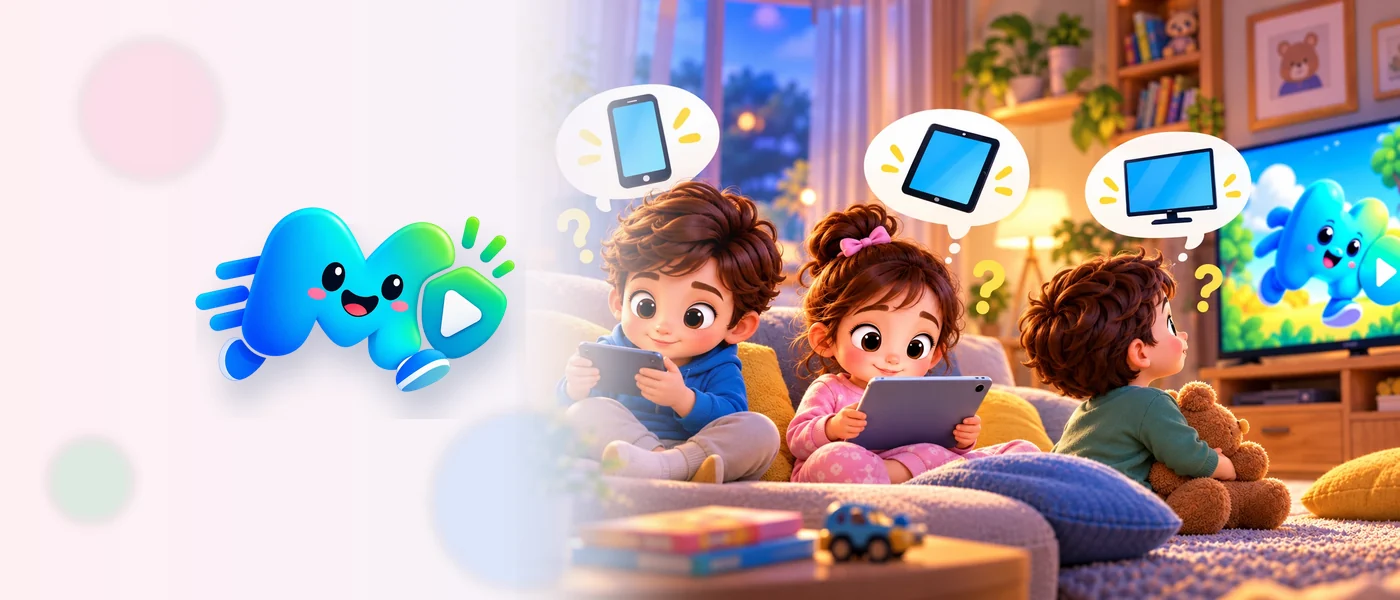
For cartoons and kids' videos specifically, the eyes usually do better with a big screen further away. A TV at the right distance is the better choice for longer watching, a tablet is a compromise, and a phone is best kept for short moments.
But it's not that one screen is "safe" and another "ruins eyesight". For children's eyes, what matters more is the distance to the screen, how long they watch without a break, time outdoors and breaks.
The American Association for Pediatric Ophthalmology and Strabismus (AAPOS) advises watching shows and films on a TV from the couch rather than on a phone or tablet when possible: a close screen makes the eyes work harder to focus.
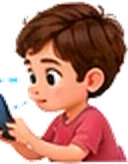
 Heaviest strain
- Small screen — kids hold it very close
- Heavy strain on the eyes
- More often causes tired, dry eyes
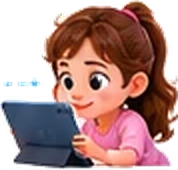
 A good compromise
- Bigger screen than a phone
- Less strain at the right distance
- Easy to use on a stand
- Still counts as close-up viewing
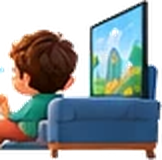
 Best for the eyes
- Big screen and more distance
- Less focusing strain
- Great for watching as a family
- Long viewing still needs breaks
Why does a close screen strain the eyes more?
When a child looks into the distance, the eyes are more relaxed. When the screen is very close, the eye keeps focusing at a short distance. This isn't only about phones — the same happens with long reading, drawing and other close work.
Research links lots of such near work with a higher chance of myopia (short-sightedness) in children. A meta-analysis of 33 studies found this link too, although results varied a lot between studies.
The problem with a phone isn't so much the phone itself as how it's typically used: small screen → the child brings it closer → stares at one spot for a long time.
Phone
The most convenient option for adults: hand it over in the car, a queue or a café — done. But for longer watching it's the least suitable: phones are usually held much closer to the face, and small details make kids bring the screen closer still.
Long use of digital devices can cause what's called digital eye strain:
- tired eyes
- dryness and burning
- headaches
- temporarily blurred vision
- trouble shifting focus from near to far
Keep the phone for a short video, a video call or when there's really no other screen. Several episodes in a row are better on a bigger screen.
Tablet
The middle option. The screen is much bigger, so there's no need to hold the device right in front of the eyes. But it's still close-up viewing.
AAPOS advises not holding screens too close and, where possible, keeping them about an arm's length away; myopia-prevention guidance also suggests keeping books and screens no closer than about 30 cm.
A stand helps a lot: in their hands kids gradually bring the tablet to their face, while on a table the distance is much easier to control. Tablets are good for learning apps and moderate watching with breaks.
TV
For a cartoon or a long video, a TV is usually the easiest on the eyes — the screen is simply much further away, so the eyes don't have to focus at 20–30 centimetres for long.
There's a condition, though: don't sit a metre away just because the screen is big. In a study of Chinese schoolchildren, watching TV from 3 metres or closer was linked to a higher chance of myopia. It's an observational study, so it doesn't prove distance was the cause, but it underlines the importance of habits.
So a TV can be watched as much as you like? No. A big screen only solves part of the problem — distance. Hours in front of the TV still push out movement, walks, play and sleep. The WHO recommends no more than one hour of screen time a day for children aged 2–4 (less is better), and no sedentary screen time for one-year-olds.
WHO guidelines for children under 5 (2019)
How can screens affect a child?
 Tired, dry eyes
Children blink less while watching.
 Higher myopia risk
Frequent close-up work is linked to a higher risk of myopia (according to research).
 Strain on posture
Sitting in one position for long can strain the neck and back.
 Sleep problems
Bright screens in the evening can interfere with melatonin and worsen sleep.
Do screens really cause short-sightedness?
It's important not to scare parents. Science can't say "watched a phone for two hours → ruined eyesight". The link is far more complex.
A large meta-analysis of 45 studies (over 335,000 participants) found that each extra daily hour of screen time was linked to a higher chance of myopia, most noticeably between about 1 and 4 hours a day. But the authors stress that confidence in the evidence is low: most studies were observational and can't prove direct cause and effect.
Also, a child who spends a lot of time on a phone often spends less time outdoors and more time doing close work at the same time — it's hard to separate the factors. That's why current guidance focuses not on fighting a particular device but on breaks, distance and time outdoors.
Time outdoors really matters for eyesight
This is one of the most convincingly supported factors. A meta-analysis of seven randomised trials (over 9,400 children) showed that programmes adding time outdoors reduced new cases of myopia. Other large studies agree: children who spend more time outside are, on average, less likely to become short-sighted.
Sometimes the best way to "protect the eyes from the phone" isn't a special filter — it's finishing the cartoon and going outside.
Why does a child rub their eyes after a screen?
When we watch attentively, we blink less and the tear film dries faster. Hence the chain: dryness → burning → a gritty feeling → redness → temporary blur. One more reason not to watch for long stretches without stopping.
The 20–20–20 rule
AAPOS recommends: every 20 minutes, look about 6 metres (20 feet) away for at least 20 seconds. That gives the eyes a short break from focusing up close. With a little one there's no need for a strict timer: the cartoon ends → stand up → look out of the window → have some water → move around.
What about blue light?
There are lots of myths here. It hasn't been shown that blue light from ordinary screens damages the retina. The American Academy of Ophthalmology says there's no scientific evidence that special glasses are needed for screen light, and a Cochrane review of 17 randomised trials found no convincing benefit of blue-light-blocking glasses for digital eye strain.
Moving the screen back, taking a break and going outside is far more useful than buying your child "phone glasses".
4 simple rules for safer watching
 Limit time
For children aged 2–4 the WHO recommends no more than 1 hour a day.
 Take breaks
The 20–20–20 rule: every 20 minutes, look 6 metres away for 20 seconds.
 Play outside more
Daily time outdoors lowers the risk of myopia.
 Mind the light
Watch in good light, without glare, and not in complete darkness.
So what should you choose?
Best for a long cartoon: big screen, big distance.
A good compromise — especially on a stand at a normal distance.
For short use: its small screen is usually held closest to the eyes.
That doesn't mean 10 minutes on a phone is worse than two hours of TV. How long and how kids watch matters more than the name of the device.
The key rule for parents
There's no need to fear screens. Keep an eye on four things: distance, breaks, time outdoors and how long they watch. A phone won't "ruin eyesight" in one cartoon, and a TV doesn't become good for kids just because it's big.

A healthy screen routine is when a child watches good content, puts the device down and happily goes back to play, walks and everyday life. That's how we build Mitti GO: technology should help parents choose good content, not keep kids in front of the screen.
verified_userParents choose. Kids watch.How it works →